
Due to energy’s pivotal role in driving global and national economic growth across sectors like industrialization, heating, cooking, and transportation, it has attracted extensive multidisciplinary analysis. Key issues emerging from these reviews include energy efficiency, security, transition, sustainable production and use, climate change, net-zero emissions, carbon capture, and carbon credits, topics that gained prominence before and after the 1970s energy crisis.
Energy is the capacity to do work. It may exist in potential, kinetic, thermal, electrical, chemical, nuclear, or other forms.[1]Energy can be harnessed and captured from diverse sources and used by humans to meet human needs.
Energy can be categorised as follows:
- Primary (raw sources) and secondary forms of energy which are energy obtained from the primary energy;
- Commercial (market traded) and non-commercial energy (traditional and non-monetized);
- Renewable (established) and non-renewable energy (finite);
- Conventional energy (established) and non-conventional energy (emerging); and
- Modern (efficient technologies) and traditional energy (basic uses).
Major types of energy in the world, global reserves, and Nigeria reserves on the list.
Energy types will be assessed under renewable and non-renewable energy sources.
RENEWABLE ENERGY SOURCES
Renewable energy is energy derived from natural sources that are replenished at a higher rate than they are consumed. The common sources of renewable energy are listed below:
- Solar Energy– the rate at which solar energy is intercepted by the earth is about 10, 000 times greater than the rate at which humans consume energy. Solar technologies deliver heat, cooling, natural light, electricity, and fuel for a host of electrical applications. Though not all countries are equally endowed with solar energy, a significant contribution to the energy mix from solar energy is possible for every country.
- Wind Energy- this type of energy harnesses the kinetic energy of moving air by using large wind turbines, which can be located offshore or onshore. Wind speeds vary considerably by location, the UN asserted that the world‘s technical potential for wind energy exceeds global electricity production. Offshore wind power offers tremendous potential.
- Geothermal Energy- this type utilises the accessible thermal energy from the earth’s interior. Heat is extracted from geothermal reservoirs using wells or other means. We have hydrothermal and enhanced geothermal systems.
- Hydropower harnesses the energy of water moving from higher to lower elevations. It can be generated from reservoirs and rivers. Hydropower is the largest source of renewable energy in the electricity sector.
- Ocean energy-this energy is derived from technologies that use the kinetic and thermal energy of seawater -waves or currents to produce electricity or heat. It is energy generated from tidal waves. The UN said the theoretical potential for ocean energy easily exceeds present human energy requirements.
- Bioenergy-it is produced from a variety of organic materials, called biomass, such as wood, charcoal, dung, and other manures for heat and power production, and agricultural crops for liquid biofuel.[2]
NON-RENEWABLE ENERGY SOURCES
Non-renewable energy sources are energy that are carbon-based except for nuclear and are limited in supply and cannot be used sustainably. There are four major types of non-renewable energy sources and they are crude oil, natural gas, and coal (Fossil fuels- which are formed within the earth from dead plants and animals over millions of years) and nuclear energy.
Examples of non-renewable energies are listed below thus:
a. Natural gas is mainly composed of methane. There are two types of natural gas biogenic gas and thermogenic gas. Natural gas is found with petroleum in reservoir rocks with coal deposits and these fossil fuels are extracted together. When natural gas cannot be captured and transported it is flared or burned at well sites, which converts it to CO2. It is considered safer and better than releasing methane into the atmosphere.
RESERVES AND NIGERIA RANKING–
At the end of 2022, the world proven natural gas reserves increased by 2.4% to approximately 210.06 trillion standard cubic metres (trscum)[3] The world has proven reserves equivalent to 52.3 times its annual consumption. This means it has about 52 years of gas left (at current consumption levels and excluding unproven reserves). Nigeria is ranked 9th in the world in natural gas reserves amounting to 2.6% world share.[4] Nigeria had 5.91 trillion cubic metrics of proved natural gas reserves in 2022. The amount increased slightly compared to the previous year, continuing the upward trend observed over the period under review.[5]
b. Crude oil is usually found one or two miles below the earth‘s surface whether on land or in the Oceans’ bed. Once the crude oil is extracted it must be refined and separated into different types gas, diesel, tar, and asphalt. Other sources are tar sands and oil shale.
RESERVES AND NIGERIA RANKING-
Global oil reserves as of 2021 are 1.734 trillion barrels, while Nigeria ranked 11 out of the 98 oil-producing nations in the world with 36, 900,000,000.00 barrels accounting for 2.1% of the world share.[6]
c. Coal unlike crude oil is a solid. Current world reserves of coal are estimated at 826,000 million tonnes. Coal is plentiful and inexpensive. Coal combustion emits a higher amount of carbon dioxide per unit of energy than oil or natural gas.
RESERVES AND NIGERIA RANKING–
As of December 31, 2021, estimates of the total world proved recoverable reserves of coal were about 1,161 billion short tons (or about 1.16 trillion short tons), and five countries had about 75% of the world’s proved coal reserves.[7] The proven coal reserves in Nigeria are about 639 million metric tonnes why inferred reserves are about 2.75billion metric tonnes[8] Worldometers believed Nigeria holds 379 million tons of proven coal reserves and ranked 44th in the world accounting for 0.00 percentage[9].
d. Nuclear power is the energy released from the radioactive decay of elements, such as uranium, which releases large amounts of energy. Nuclear power plants produce no carbon dioxide and need quite a large amount of steel. Currently, world production of electricity from nuclear power is about 19.1 trillion kWh and the USA is consuming about 22% of that.
GLOBAL GENERATION CAPACITY-
Global nuclear power generation reached 2,487 terawatt-hours in 2022, a year-over-year decrease of nearly seven percent. Figures have seen a mostly increasing trend since 2012 but decreased in 2020 and 2022.[10]Nigeria has no nuclear power generation reactor.
What dominated the Nigeria energy system before discovery of oil.
Power generation in Nigeria dates back to 1886 when two generating sets were installed to serve the then Colony of Lagos. The first electric utility company known as Nigerian Electricity Supply Company was established in 1929. By an Act of Parliament in 1951, the Electricity Corporation of Nigeria was established and in 1962, the Niger Dam Authority was also established for the development of hydroelectric power.
A merger of the two organizations in 1972 resulted in the formation of the National Electric Power Authority (NEPA) which was saddled with the responsibility of generating, transmitting, and distributing electricity for the whole country. In 2005, as a result of the power sector reform process, NEPA was unbundled and renamed Power Holding Company of Nigeria (PHCN), and the Electricity Act, of 2023 followed in the wake.
Oil in commercial quantity was discovered at Oloibiri in present-day Bayelsa State in 1956 by Shell D’arcy, but before the discovery of oil, electricity generation was hydro in Nigeria and coal-powered. In 1923 tin miners installed a 2MW plant on the Kwali River, six years later, a private firm was set up to manage the hydroelectric plant at Kura to power the mining industry. Electricity Corporation of Nigeria took over the electricity sector and in 1951 ECN managed 46 MW of electricity.[11] Between 1952 and 1960, ECN established coal-powered turbines at Oji and Ijora Lagos.[12]
Three energy forms before the discovery of crude oil are from biofuel to coal, coal to hydrocarbon, and from hydrocarbon to renewable energy sources. it should be mentioned that it is an ongoing process, and there persists a mix of the energy in varying proportions. Nigerians rely majorly on bioenergy and transited to coal after its discovery in 1909 in Enugu Nigeria. Without technology, available energy remained dormant in Nigeria in the colonial period.[13] The major requirement for energy was to power ships, for example about 446 ships called on Nigeria Harbours in 1893. In 1923 coal fired plant was commissioned in Enugu for power generation to generate about 3.6MW, and since the major mode of transportation in need of energy was rail, rail was constructed to convey raw commodities from the hinterland to the coastal towns for export of raw commodities overseas. The ships and rails were powered by coal and steam engines.[14] The percentage of the energy dominant in that era in Nigeria is quite frankly unknown, but we can suggest that biofuel took the lion’s share, followed by the coal during the pre-colonial and colonial era in Nigeria, and before the discovery of crude oil and natural gas.
What dominated the energy system before the discovery of oil were bioenergy or biomass and coal. Coal was the major source of energy for Nigeria as it was used to power electricity plants. Why Biofuel was the major source of energy for energy needs of majority of Nigeria homes.
The current Nigeria ‘s energy mix and scenarios.
Notwithstanding the several policies, laws, and plans of the Nigerian government, to transition from non-renewable energy sources to renewable energy sources, Nigeria’s energy generation mix is still dominated by non-renewable energy resources. Currently, the on-grid energy mix in Nigeria is dominated by thermal (80%) and hydro (20%) power generating sources, while other renewable energy generation such as solar and biomass are heavily deployed for the electrification of rural areas and semi-urban areas which are out of the distribution companies reach.[15]
Nigeria generates nearly all of its electricity from fossil sources, with a staggering 51.66 terawatt-hours (TWh) coming from fossil fuels. This far outweighs the 8.27 TWh generated from what’s more, low carbon hydropower. Rounded off, this means approximately six-sevenths of all energy in Nigeria is fossil-based, with only about one-seventh being low-carbon. Compared to the global average of 408 watts per person, electricity generation in Nigeria is heavily reliant on fossil sources, which in the long run can lead to an increase in air pollution and contribute to climate change.[16]
SCENERIOS
Hydropower
The total technically exploitable large-scale hydropower potential of the country is estimated at over 10,000 MW, capable of producing 36,000 GWh of electricity annually. Only about 15% of this potential had been developed as of 2012. The small and medium-scale hydropower potential is estimated to be greater than 3,500 MW of which less than 2% had been harnessed as of 2012.[17]
Biomass
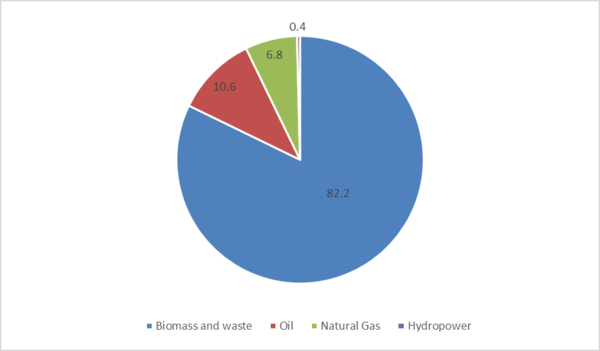
The current biomass capacity of Nigeria is over 200 billion kg of biomass per year. Wood fuel and charcoal account for over 80% of the energy that is consumed in households in Nigeria for cooking and heating. Wood fuel accounts for about 94% of traditional biomass, that is utilized for household cooking in Nigeria. 46 million tonnes of wood fuel was used in 2014 for domestic cooking in the country. The nation’s total energy consumption in 2015 was 121 Mtoe. It was revealed that Nigeria has the potential to generate about 62 Mtoe (2.6 billion GJ) of energy from its biomass resources (about 51% of the nation’s energy consumption in 2015). The largest resource by far is agricultural crop residue, much of which is currently burnt in the fields. The estimated bioenergy potential of Nigeria’s forest residue (8.7 Mtoe equivalent to 363 PJ) is 1.04 times greater than the energy consumed for transportation and four times greater than the nation’s electricity consumption in 2015.[18]
Solar
Nigeria lies within a high sunshine belt and within the country; solar radiation is fairly well distributed. The annual average of total solar radiation varies from about 12.6 MJ/m2-day in the coastal latitudes to about 25.2 MJ/m2-day in the far North. Solar energy is renewable and its utilization is environmentally friendly The Chief Executive Officer, Association of Power Generation Companies, Joy Ogaji, while making a presentation titled, ‘The Electricity Act 2023: Options for renewable energy penetration and role of stakeholders’, said more than 420,000MW of power could be generated from solar energy in Nigeria..[19]
Wind
The annual average wind speed at 10m heights varies from about 2 m/s in the coastal areas to about 4 m/s in the far north. At 50m, the range is 2m/s to 8m/s. It is possible to convert wind energy to rotary mechanical energy and electrical energy for a variety of uses.[20]
Geothermal, Wave and Tidal Energy
Geothermal, wave, and tidal energy resources are among the various energy resources that are available in Nigeria. Although these resources are not in use for energy supply at the moment, this policy encourages relevant agencies to ensure that data and information relating to these resources are obtained through research and development programmes with a view to immediately commence using these resources to provide power supply where ever it is competitive..[21]
On-grid Renewable Electricity supply
To sustain such growth, Nigeria’s electricity generation would have to increaseby significantly more than the projected growth rate. Analysis of energy consumption by similar economies suggests the need for over 40,000MW of electricity by 2030. Therefore, by 2030, Nigeria might need to increase electricity generation over sevenfold. The projected growth rate required to achieve Vision 20:2020 will demand even greater production than 40,000 MW by 2030.[22]
Off-grid Renewable Electricity supply.
According to the REA of Nigeria, developing off-grid alternatives to complement the grid creates a $9.2B/year (₦3.2T/year) market opportunity for mini-grids and solar home systems that will save $4.4B/year (₦1.5T/year) for Nigerian homes and businesses. The agency estimates that there is a large potential for scaling considering the large swath of the unserved customer population.
Currently, Solar Home Systems, Solar C&I systems, Solar Mini-grids, and other off-grid gas-fired solutions dominate the off-grid space in Nigeria. As of 2019, Nigeria’s total off-grid electricity generation capacity approved by the NERC was about 500MW (Rural Electrification Agency, 2019). Of this number, solar mini-grids accounted for roughly 3MW.[23]
Conclusion.
Nigeria’s current energy mix slants more towards non-renewable energy, and this flies in the face of Nigeria’s commitment to net zero emissions by 2060. Several policies and even the Climate Change Act, of 2021 have set the foundation for energy transition but Nigeria seems to moving at a snail’s pace, and unfortunately so.
Author: Femi Adisa-Isikalu’s literary oeuvre is a cornerstone of his legacy, bridging theory and practice while enriching Nigerian jurisprudence: Co-Author: Understanding and Use of Letters of Credit: A Pragmatic, Legal, and Novel Approach (2020), a seminal work demystifying international trade finance and usage of letters of credit in international trade and business. Author: Civil Procedure Forms and Precedents for Effective Civil Law Practice (1st Edition, 2018; 2nd Edition, 2024), An indispensable guide for practitioners, featuring over 200 templates that streamline litigation and enhance procedural efficiency in Nigeria courts. Author: Models of Commercial Contracts in Nigeria. Editor: Nigerian Company and Securities Law Reports (NCSLR) (7 Volumes, 2019–2023, under Prof. Joe Abugu)-Curated landmark judgments, influencing corporate governance reforms and cited in superior court decisions. and also Author: 2,000 Biblical Names of God (2021), A reflective exploration at the intersection of faith and ethics, offering spiritual insights into knowing God through His many names.
END NOTES
[1] https://www.britannica.com/science/energy accessed on the 28th of December, 2023
[2] https://education.nationalgeographic.org/resource/nonrenewable-resources/ accessed on the 28th of December, 2023.
[3]https://asb.opec.org/ASB_KeyMessages.html#:~:text=At%20the%20end%20of%202022%2C%20world%20proven%20natural%20gas%20reserves,at%20the%20end%20of%202021.
[5] https://www.statista.com/statistics/1387331/proved-natural-gas-reserves-in-nigeria/#:~:text=Nigeria%20had%205.91%20trillion%20cubic,over%20the%20period%20under%20review.
[6] Statistical Review of World Energy 2021 | 70th edition at page 2.
[7] https://www.eia.gov/energyexplained/coal/how-much-coal-is-left. Accessed on the 28th of December, 2023.
[8] https://www.bpe.gov.ng/nigerian-coal-corporation/.
[9] https://www.worldometers.info/coal/coal-reserves-by-country/ accessed on the 28th of December, 2023.
[10] https://www.statista.com/statistics/275048/gloobal-nuclear-power-generation/#:~:text=Global%20nuclear%20power%20production%201985%2D2022&text=Global%20nuclear%20power%20generation%20reached,decreased%20in%202020%20and%202022.
[11] Simpson, E. S. (July 1969). “Electricity Production in Nigeria”. Economic Geography. 45 (3): 239–257. doi:10.2307/143093. ISSN 0013-0095. JSTOR 143093.
[12] ibid
[13]Chukwuebuka Okafor, Christian Madu, Charles Ajaero, Juliet Ibekwe, Happy Bebenimibo, Chinelo Nzekwe. Moving beyond fossil fuel in an oil-exporting and emerging economy: Paradigm shift[J]. AIMS Energy, 2021, 9(2): 379-413. doi: 10.3934/energy.2021020
[14] ibid
[15] International Trade Organization Report on Electricity, Power Systems and Renewable Energy (Nigeria- Commercial Guide Report), June 2023.
[16] https://lowcarbonpower.org/region/Nigeria
[17] The Nigerian National Renewable Energy and energy efficiency policy (NREEP), approved by FEC for the Electricity Sector by Ministry of Power of the Federal Republic of Nigeria at page 10
[18] Olanrewaju F., Andrews G., Li H., Phylaktou H., 2019, Bioenergy Potential in Nigeria, Chemical Engineering Transactions, 74, 61-66 DOI:10.3303/CET1974011
[19] https://punchng.com/nigeria-can-generate-427000mw-from-solar-gencos/ accessed on the 29th of December, 2023.
[20] The Nigerian National Renewable Energy and energy efficiency policy (NREEP), approved by FEC for the Electricity Sector by Ministry of Power of the Federal Republic of Nigeria at page 15
[21] Ibid at page 17.
[22] Ibid at page 18.
[23]https://energypedia.info/wiki/Nigeria_Electricity_Sector#:~:text=As%20of%202019%2C%20Nigeria’s%20total,grids%20accounted%20for%20roughly%203MW.
Leave a Reply